|
Getting your Trinity Audio player ready...
|
A step-by-step lying down shower routine for when standing isn’t an option
The first thing I notice is the warmth. Warm water running over my feet, my legs, my shoulders — all while I’m lying flat on the shower floor. My partner adjusts the handheld shower head. The bathroom is already warm from the space heater we turned on an hour ago. For the next 45 minutes, I don’t have to be anywhere. I just get to be clean.
For most people, a shower is mindless. For me, it’s a project — one that takes a transport chair, my partner’s help, and a whole lot of planning. Living with severe ME/CFS and HyperPOTS means standing in hot water can trigger dizziness, shaking, and the kind of crash that takes days to recover from. So about once a month, I follow a lying down shower routine on the bathroom floor.
It’s genuinely one of the best parts of my month.
This is what works for my body. If you’re living with a similar condition, I hope it gives you a starting point — but please adapt everything to your own needs and energy levels.
A note for those with MCAS: If your mast cell activation syndrome isn’t well managed, exfoliating scrubs and new products can potentially trigger a reaction. Please test any new product on a small area first and wait to see how your body responds before using it more broadly. For more on managing MCAS, see my MCAS Kitchen Sink Protocol.
Before I Figured Out My Lying Down Shower Routine
For a long time, shower day was something I dreaded. I’d put it off as long as I could — not because I didn’t want to be clean, but because every attempt left me wrecked. Sitting on a shower chair still triggered my POTS. The heat made my heart race. By the time I was done, I’d be shaking and would need days to recover. Sometimes the crash would be so bad I’d think, was it even worth it?
I started to accept that maybe showers just weren’t something my body could do anymore. But giving up on something that basic didn’t sit right with either of us — so my partner and I started experimenting. What if I didn’t have to sit up at all? What if we brought the shower to me, on the floor?
It took a few rounds of trial and error. The first time we tried it without a bath pillow and I lasted about ten minutes on the hard tile before we gave up. We learned that a standard shower hose is useless when you’re lying down — it barely reaches your hips. We learned that the bathroom needs to be pre-warmed or the whole thing falls apart. But slowly, we figured out a system. And now, once a month, it works.
My Lying-Down Shower Routine: Step by Step

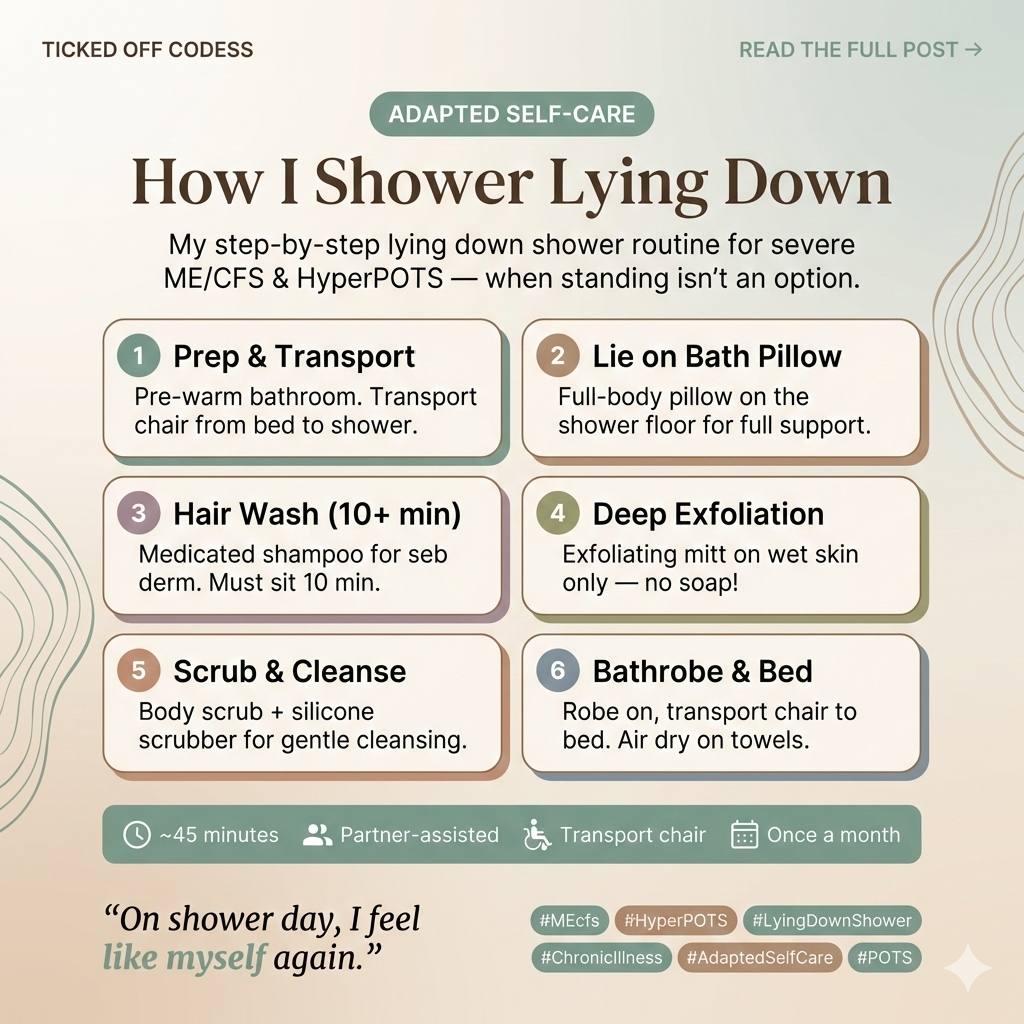
To shower lying down, you need a full-body bath pillow on the shower floor, an extra-long handheld shower hose, and a partner or caregiver to assist with transfers and drying. Before we start, my partner and I do a little prep: we turn off the A/C about an hour beforehand and sometimes bring a small space heater into the bathroom. Staying warm throughout the process is critical — chills can ruin the whole experience and waste precious energy. We also lay towels out on the bed for drying off afterward, so everything is ready before I use any energy.
When it’s time, my partner wheels me from the bed to the bathroom in a transport chair, then helps me get settled on the shower floor. Here’s how the shower itself works:
Lying Down Shower Routine for Severe ME/CFS and HyperPOTS
A step-by-step adapted shower routine for people with ME/CFS, HyperPOTS, and other conditions that make standing showers unsafe.
Total Time: 45 minutes
1. Set up a comfortable base.
We lay a full-body bath pillow on the shower floor so I can lie flat with head, neck, and back support. This makes a huge difference — without it, the hard floor would make the whole thing miserable.
2. Use a handheld shower head with an extra-long hose.
I hold the shower head myself and adjust the water as needed. An extra-long shower hose is a game-changer — anything standard length and I’d have to sit up to rinse my legs. We use a 198-inch hose, though in hindsight the 138-inch would have been plenty. Either way, the length means I can reach every part of my body without straining or changing position.
3. Hair wash.
This is the most time-consuming step. I have seborrheic dermatitis, so I need to use medicated shampoos that have to sit on my scalp for about ten minutes to be effective. Between the application, the wait time, and rinsing, my hair routine alone accounts for a big chunk of the 45 minutes. But skipping it isn’t an option — when you only shower once a month, your scalp needs the extra care.
4. Deep exfoliation.
Since I can only shower once a month, exfoliation is essential. We use a deep exfoliating mitt to gently remove the buildup of dead skin. Important: don’t use soap on the mitt — it actually makes it less effective. Just use it on wet skin. This step alone makes a noticeable difference in how clean I feel afterward.
5. Scrub and cleanse.
After exfoliating, I apply a nourishing body scrub and follow up with a silicone body scrubber for gentle, thorough cleansing. The silicone scrubber is easy to grip and soft enough for sensitive skin, which matters when your body is already under stress.
6. Dry off without getting up.
Getting up and toweling off would undo all the energy savings, so instead, my partner helps me slip into a cozy bathrobe while I’m still on the shower floor. Then I get back into the transport chair and my partner wheels me to the bed, where we’ve already laid out towels. I lie down and air dry. No standing, no rubbing, no extra exertion.
It’s definitely a process, and it took us a few tries to get the setup right. But it leaves me feeling refreshed, clean, and cared for — without triggering a full-on crash.
Caregiver Support: A Note About My Partner
I want to pause and say something about the person who makes all of this possible. Shower day isn’t just a big deal for me — it’s a commitment from my partner too. They prep the bathroom, help me transfer, manage the water temperature, assist with the steps I can’t do alone, and then get me settled back in bed afterward. It’s 45 minutes of focused, hands-on care.
I know not everyone has a partner or caregiver who can help with this, and I don’t take it for granted. If you do have someone willing, I’d encourage you to talk through the routine together before attempting it. Having a plan makes it less stressful for both of you. And to the caregivers reading this — what you do matters more than you know.
Products for My Lying Down Shower Routine
Here are the tools I rely on, matched to each step of the routine. I’ve tried to include what I actually think of each one, not just what it does.
For lying down comfortably:

- VOXOR Full Body Bath Pillow (60” x 16”) — This is the foundation of the whole routine. It cushions my entire body on the shower floor with a built-in headrest for neck and back support. We tried a regular bath mat first — it was not even close. The VOXOR is thick enough to actually be comfortable for 45 minutes, which is the real test. Worth every penny.
For reaching everything from the floor:

- OFFO Ultra-Flex Shower Hose, 198 in (Matte Black) — An extra-long hose is non-negotiable. We started with the standard hose that came with our shower head, and it was immediately obvious it wouldn’t work — I couldn’t rinse anything below my waist without sitting up. We bought the 198-inch version, and while it definitely reaches everywhere, in retrospect it’s longer than we actually need — the excess hose can be a bit much to manage on the floor. If I were buying again, I’d go with the 138-inch version from the same brand. Either way, anything over 100 inches will transform this routine.

- SR SUN RISE 9-Settings High-Pressure Handheld Shower Head (Matte Black) — Nine spray settings, detachable with a wall mount bracket, and lighter than a lot of other shower heads I’ve looked at. The gentle rain setting is what I use most — strong enough to rinse shampoo but not so intense that it’s overwhelming when you’re lying right under it.
For exfoliating and cleansing:

- Dermasuri Deep Exfoliating Glove — This is the product that makes the biggest visible difference. After a month between showers, the dead skin buildup is real, and this mitt gets rid of all of it. Be gentle though — a little pressure goes a long way, and you might be surprised at the results. And remember: no soap on this mitt, just wet skin. Soap actually reduces its effectiveness, which I learned the hard way.

- Olay Indulgent Mineral Scrub, Guava & Coconut (11 oz) — This one is purely a treat. It’s nourishing, has exfoliating pearls and a BHA formula for gentle chemical exfoliation, and it smells incredible. After using the Dermasuri, applying this scrub feels like an actual spa experience. It’s the part of the routine that makes shower day feel special instead of just functional.

- Sud Scrub Antimicrobial Silicone Body Scrubber (Pink) — I use this with the Olay scrub for the final cleansing pass. It’s soft, antimicrobial (so it doesn’t get gross between monthly uses), and the built-in handle makes it easy to grip even when my hands are wet and I have zero energy for squeezing. Gentle enough for sensitive skin, which is a must for me.
What I Wish I’d Known About Showering with ME/CFS
If you’re thinking about trying a lying down shower routine, here are a few things I learned the hard way:
You need a much longer hose than you think — but not too long. A standard shower hose is maybe 60 inches. When you’re lying on the floor, that barely reaches your midsection. We bought the 198-inch version, which works but is honestly more hose than we need — there’s a lot of extra length to manage on the floor. In retrospect, the 138-inch hose would have been the sweet spot.
Pre-warm the bathroom. I cannot stress this enough. Even if the water is warm, lying wet on the floor in a cold room will make you miserable and can waste energy you don’t have. Turn off the A/C and turn on the heater or bring in a small space heater at least an hour before.
Don’t skip the bath pillow. We tried cushioned bath mats, folded towels, even a yoga mat. None of them were comfortable for more than a few minutes. A proper full-body bath pillow is the difference between a routine you dread and one you look forward to.
The Dermasuri mitt works best without soap. I used it with soap for the first few months and thought it was fine. Then I tried it on just wet skin and the difference was dramatic. Save the soap and scrub for after exfoliating.
It’s okay if the first time is rough. Our first attempt was awkward, uncomfortable, and we didn’t finish. It took three or four tries before we had a system that actually worked. Don’t give up after one go.
Frequently Asked Questions
Q: Can you shower lying down with POTS?
A: Yes — lying down minimizes the orthostatic stress that triggers POTS symptoms like dizziness and tachycardia. I use a full-body bath pillow on the shower floor and a 198-inch handheld shower hose to shower completely lying flat.
Q: How often can you shower with severe ME/CFS?
A: This varies by severity. I shower about once a month. The key is building a routine that doesn’t trigger post-exertional malaise (PEM), which means conserving energy at every step — transport chair, lying down, partner assistance, and air drying.
Q: What products do you need for a lying down shower?
A: The essentials are a full-body bath pillow for the shower floor, an extra-long handheld shower hose (at least 100 inches), and a handheld shower head. I also use an exfoliating mitt, body scrub, and silicone scrubber since I only shower monthly.
Q: Is it safe to shower lying down?
A: For me, it’s safer than standing or sitting, because it eliminates the orthostatic stress that causes dizziness and crashes. Having a partner or caregiver present is important for safety and assistance. Always adapt to your own body’s needs.
Why Showering Lying Down Works for ME/CFS and POTS
Showering lying down won’t work for everyone, and it took us a few tries to figure out the right setup. But for me, it minimizes dizziness, prevents overheating, and makes real hygiene possible even at my lowest. For more on managing daily activities with ME/CFS, the Bateman Horne Center’s ME/CFS Crash Survival Guide is an excellent resource.
I don’t do it daily — once a month is what my body allows. But on that day, I feel like myself again. There’s something about being truly clean that goes beyond physical comfort. It’s dignity. It’s a small thing that feels enormous when your world has gotten very small.
If you’re living with severe ME, POTS, or any condition that makes standing showers unsafe, I hope this gives you a starting point. You deserve to feel clean and cared for, even on your hardest days.
I’d love to hear from you. If you’ve found ways to make showering work with limited energy — lying down, seated, or something else entirely — share your tips in the comments. The more ideas we put out there, the more people we help.
Post Disclaimer
The information contained in this post is for general information purposes only.
The Ticked Off Codess is a blog sharing my experiences and opinions as a patient with multiple complex chronic illnesses. It does not intend to provide professional, legal, or medical advice. I share what has helped me, which may not necessarily help others. YMMV. Before trying anything, you should consult with your medical professional.
The information is provided by Ticked Off Codess and while we endeavour to keep the information up to date and correct, we make no representations or warranties of any kind, express or implied, about the completeness, accuracy, reliability, suitability or availability with respect to the website or the information, products, services, or related graphics contained on the post for any purpose.
To Readers: The content of this blog is based on my research, knowledge, and perspective. It may not reflect the views or practices of other patients or organizations. I do not endorse or promote any products, services, or websites I mention or link to in this blog. I am not responsible for the accuracy, completeness, or suitability of the information I provide or that you obtain from this blog or its links. You should always verify the information and use your judgment before applying it to your situation.
To Commenters: The comments section of this blog is open for discussion and feedback. However, I reserve the right to moderate, edit, delete, or block any comments that are abusive, offensive, spammy, or irrelevant. I also reserve the right to ban any users who violate these rules or the terms of service of this platform. The opinions commenters express are theirs and do not necessarily represent my views or opinions.
Pingback: The MCAS Kitchen Sink Protocol: How I Manage Mast Cell Activation Syndrome With a Layered Treatment Approach - Ticked Off Codess