|
Getting your Trinity Audio player ready...
|
Living with severe ME and HyperPOTS means my body doesn’t tolerate being upright — not even long enough to wash my hair over a sink. For the longest time I just… didn’t know what to do about it. Washing hair in bed sounded like something that shouldn’t be this complicated, but the actual doing of it? Couldn’t figure out how to make that happen from flat on my back.
Eventually, my partner and I cobbled something together. Tried a few things that didn’t work. Tried a few more. And somehow landed on a routine that actually gets my hair properly clean while I stay fully horizontal. (If you’re also looking for ways to adapt personal care, I’ve written about our lying-down shower routine.) It’s not glamorous. There’s usually a towel on the floor that shouldn’t be there and at least one moment where someone says “wait, it’s dripping.” But it works. And on the days we do it, I feel like a different person after.
Why We Started Washing Hair in Bed
If you’re here, you probably already know why someone might need to wash their hair lying down. But for anyone who stumbled across this post and is wondering: with severe ME, even small amounts of being upright can trigger post-exertional malaise (PEM) or a full crash. My HyperPOTS means my heart rate takes off just from sitting up. So things most people do without thinking — showering, leaning over a sink, sitting in a chair long enough to get through a wash — those aren’t options for me.
Washing my hair used to leave me wiped out for days. A shower chair still had me upright too long. Leaning over the tub? My body said absolutely not. So we started washing hair in bed. That’s where I am, that’s where the hair washing happens.
What We Tried First (and Why It Didn’t Work)
I want to mention this because I see inflatable hair washing basins recommended constantly in chronic illness groups for washing hair in bed, and I don’t want anyone to feel like a failure if they don’t work for you either.
I tried one. The kind that sits around your neck while you lie back. Looked perfect in the photos. But the pressure around my neck was genuinely awful — like wearing a too-tight collar for the entire wash. When your body is already sensitised and reactive, that kind of discomfort isn’t something you can just push through. It made the whole thing worse, not better. So we ditched it and figured out something different.
Our Equipment for Washing Hair in Bed
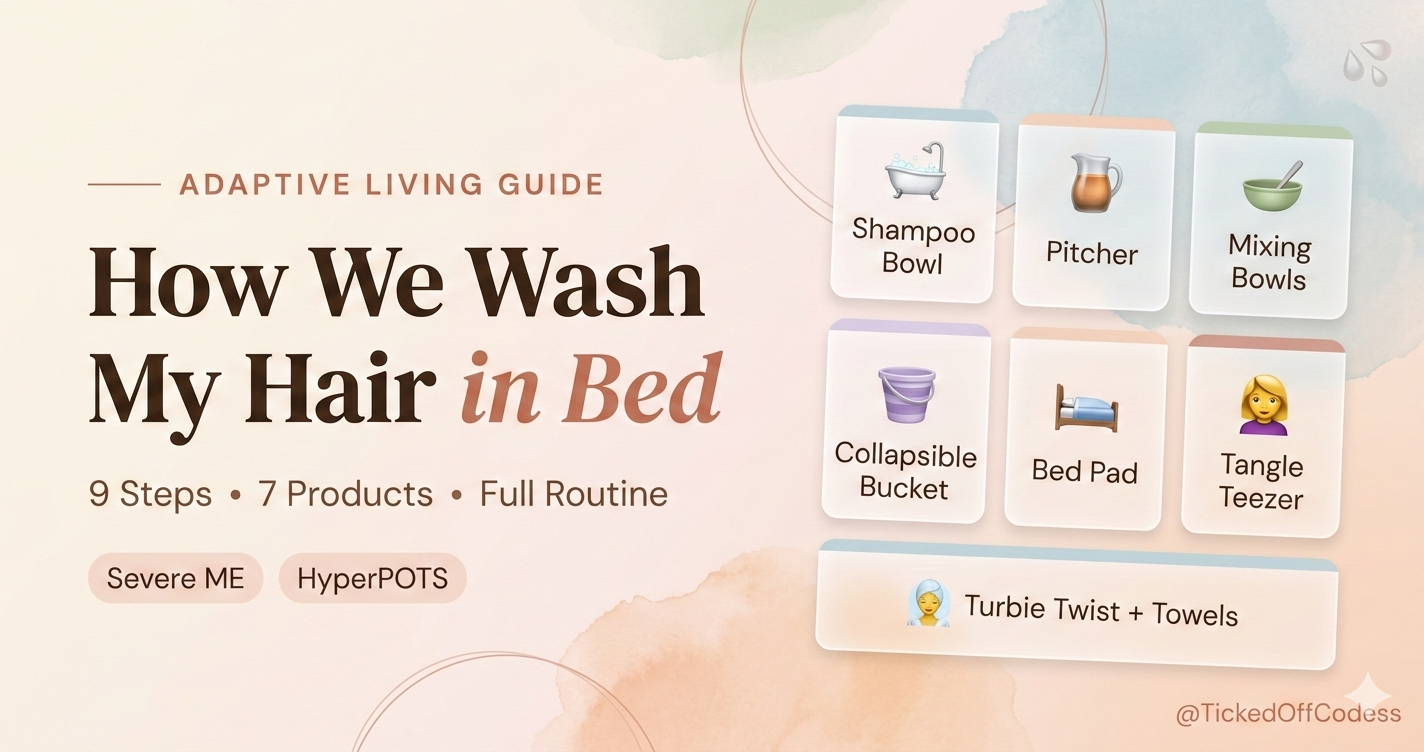
It took us a while to land on this combination. Some of it was deliberate research, some of it was my caregiver standing in the kitchen going “would this bowl work?” But this is what we use now, and it’s been solid:
The Foundation: Keeping the Bed Dry
KANECH Washable Waterproof Bed Pad (44″ x 52″) — This goes down first, right under my head and shoulders.

It’s heavy absorbency and reusable — catches whatever water escapes, and it goes straight in the washing machine after. We also layer additional towels on top and around me because water is going to go places you don’t expect. It always does. Every single time.
The Basin
DMI Portable Shampoo Bowl — This is what replaced the inflatable one, and the difference is night and day. It’s a rigid plastic bowl that sits under my head while I lie flat.

It has a contoured shape that cradles the back of your head without squeezing your neck, and there’s a drain spout so water flows out into whatever you’ve got collecting below. It doesn’t shift around mid-wash, which matters more than you’d think when you’re lying there with wet hair and soapy water.
Water Supply & Collection
JOEY’Z 1 Gallon Water Pitcher with Locking Lid — This gets filled with warm water before we start.

The locking lid is the whole reason we use this one. My partner can control exactly how much water comes out and how fast. No accidental flooding the bed. (We learned that lesson.) Having a full gallon ready also means we don’t have to stop mid-routine for a refill, which keeps things moving and keeps my energy cost as low as possible.
KitchenAid Classic Mixing Bowls (Set of 5, Aqua Sky) — We use the larger bowls for catching the water that drains from the shampoo bowl.

They nest together for storage, which helps because our bedroom is not large and it’s pulling double duty as… everything.
Thanice Collapsible Bucket (1.3 Gallon) — This sits on the floor next to the bed and catches the used water draining from the shampoo bowl.

When we’re done, it collapses flat. Storage space matters when your bedroom is also your everything room.
Our Hair Products
I won’t pretend this is a quick lather-and-rinse situation. Washing hair in bed when you can only do it every so often means you need products that actually do the job:
- Clarifying shampoo — cuts through the buildup that happens when hair wash days are spaced way further apart than most people’s
- Medicated shampoo — keeps my scalp healthy, which matters even more when washing is infrequent
- Conditioner — clarifying shampoo strips everything out, so this puts the moisture back
- Detangler — if you spend most of your time with your head on a pillow, you know why this is non-negotiable
- Tangle Teezer Fine and Fragile Detangling Hairbrush — gentle flexible bristles that don’t rip through knots or snap strands
- Turbie Twist Cotton Hair Towel Wrap — stays in place while lying down, soaks up moisture fast, and I don’t have to hold it or sit up to adjust it
- Heat protector — because we’re still looking after this hair, even if life looks different now
How We Actually Wash My Hair in Bed (Step by Step)
I’m walking through this in detail because when I was trying to figure out washing hair in bed, I couldn’t find anyone explaining the actual logistics. So here’s everything, including the boring bits:
Total Time: 1 hour
1. Prep the space.
My partner lays the waterproof bed pad down, then layers towels on top. The shampoo bowl goes under my head. Pitcher gets filled with warm water. Bowls and the collapsible bucket get positioned for drainage. Every product gets lined up within arm’s reach — once we start, neither of us wants to be hunting for the conditioner.
2. Wet my hair.
My partner slowly pours warm water from the pitcher over my hair and into the shampoo bowl. The locking lid on the pitcher is doing all the work here — it’s what keeps this from turning into a splash zone. Going slow matters. We learned that the hard way.
3. Clarifying shampoo.
First wash. My partner works it through my hair and scalp, massages it in, and then we rinse with the pitcher. The dirty water drains out of the bowl and into the collection bowl or bucket sitting below.
4. Medicated shampoo.
Second wash, this time paying extra attention to my scalp. Depending on the product, we’ll let it sit for a few minutes before rinsing. Then another rinse with the pitcher.
5. Condition.
Conditioner goes on the mid-lengths and ends mostly. A little warm water helps it spread through. We let it sit for a bit, then rinse it all out.
6. Detangle.
This is where the Tangle Teezer Fine and Fragile Detangling Hairbrush earns its place. My partner sprays detangler through my damp hair and then works through the knots with this brush. The bristles are flexible enough that they don’t just yank through tangles — they actually separate them without that horrible pulling feeling. When your hair has been pressed against a pillow for most of its life recently, gentle detangling isn’t optional. It works on wet and dry hair, which means we also use it between wash days.
Honestly this step saves so much breakage. I wish I’d found this brush sooner.
7. Towel dry.
We wrap my hair in a Turbie Twist Super Absorbent Cotton Hair Towel Wrap and it just… stays. I don’t have to hold it. I don’t have to sit up to twist it. It wraps, it stays put, and the cotton pulls out a surprising amount of water before we even get to the hair dryer. While my hair is wrapped in the turbie twist, my partner empties the buckets.
8. Heat protector & blow dry.
Once the Turbie Twist has done its thing, my partner sprays in heat protector and then blow dries on a low, warm setting. I stay lying down for all of this. We just work through it section by section until everything’s dry. It takes a while. That’s fine.
9. Clean up.
Bowls get rinsed, bed pad goes in the wash, fresh pillowcase goes back on. Done. The whole room smells like shampoo and it’s honestly one of the best parts.
What We’ve Figured Out About Washing Hair in Bed
Start the water warmer than you think. It cools down fast once it’s being poured from a pitcher into a bowl in open air. What felt perfect in the kitchen will feel lukewarm by the time it hits your scalp.
Set up everything before you start. Every time we have to pause mid-wash for a missing product or a towel that’s out of reach, that’s energy I’m spending that I didn’t budget for. Prep is everything.
This is not a fast process. And that’s okay. Some days it takes longer than others. Some days we need to stop partway through. Being gentle with the timeline is part of making this sustainable.
Talk to each other the whole time. Is the water too hot? Is the bowl digging into my neck? Do I need a minute? My partner and I check in constantly. We’ve gotten good at it.
For the Caregivers Reading This
My partner didn’t sign up for beauty school. But here they are, running what is essentially a full salon operation from our bedroom, and doing it with patience every single time. Even on the days when the bucket overflows a little. Even when I’m grumpy because I’m tired and my neck hurts.
If you’re the person pouring the water and tracking the drain and keeping the towels in place — what you’re doing matters. I know it might not feel like much, but clean hair shifts something. It’s not just hygiene. It’s dignity, and identity, and feeling like yourself again for a little while. That’s not a small thing.
If You’re Trying to Figure This Out Too
You don’t need a perfect setup to start washing hair in bed. We definitely didn’t have one at first. You need a way to catch water, a way to pour water slowly, something to protect the mattress, and someone willing to take their time with it. The rest you figure out as you go.
If you’re living with severe ME, HyperPOTS, or anything that keeps you horizontal — I hope this takes one thing off the impossible list.
Clean hair days are good days. And we all deserve those.
Have questions about how we do this, or products that work for you? I’d love to hear about it in the comments — especially if you’ve figured out tricks we haven’t tried yet.
Post Disclaimer
The information contained in this post is for general information purposes only.
The Ticked Off Codess is a blog sharing my experiences and opinions as a patient with multiple complex chronic illnesses. It does not intend to provide professional, legal, or medical advice. I share what has helped me, which may not necessarily help others. YMMV. Before trying anything, you should consult with your medical professional.
The information is provided by Ticked Off Codess and while we endeavour to keep the information up to date and correct, we make no representations or warranties of any kind, express or implied, about the completeness, accuracy, reliability, suitability or availability with respect to the website or the information, products, services, or related graphics contained on the post for any purpose.
To Readers: The content of this blog is based on my research, knowledge, and perspective. It may not reflect the views or practices of other patients or organizations. I do not endorse or promote any products, services, or websites I mention or link to in this blog. I am not responsible for the accuracy, completeness, or suitability of the information I provide or that you obtain from this blog or its links. You should always verify the information and use your judgment before applying it to your situation.
To Commenters: The comments section of this blog is open for discussion and feedback. However, I reserve the right to moderate, edit, delete, or block any comments that are abusive, offensive, spammy, or irrelevant. I also reserve the right to ban any users who violate these rules or the terms of service of this platform. The opinions commenters express are theirs and do not necessarily represent my views or opinions.